
How Often Should Australian SMEs Review Their Business Insurance

Australian small and medium enterprises (SMEs) should review their business insurance at least once a year and not only during renewal time. The safest approach is to complete an annual insurance health check and trigger an immediate insurance review whenever your business model, staff, revenue, location, or services change
Business insurance is not a set-and-forget cost. As your business grows or shifts, your insurance policy should change with it, or you risk being underinsured, overpaying, or carrying cover that no longer fits your actual risks.
Key Takeaways
- Review your business insurance at least annually and immediately after any significant operational change.
- Failing to update turnover or asset schedules can trigger coinsurance clauses, resulting in severe claim penalties where payouts are reduced proportionally to the underinsured amount.
- New products, imported goods, or staff changes create uninsured liabilities without policy updates.
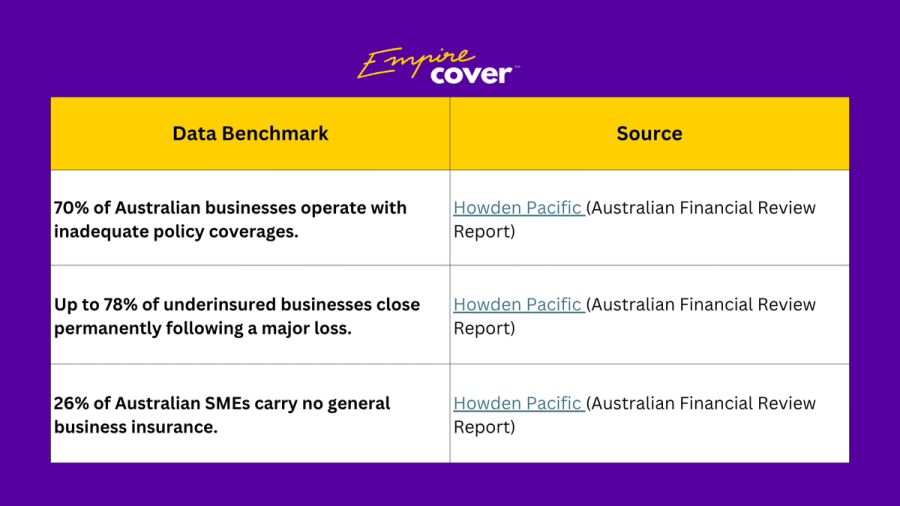
The Shocking Reality of Underinsurance for Australian Businesses
Is an Annual Business Insurance Health Check Enough for SMEs?
An annual business insurance health check is the baseline requirement, but it is rarely enough on its own for growing Australian SMEs.
If you purchase new high-value equipment in March but wait until your November renewal to update your asset schedule, any damage or theft occurring in the intervening eight months will be capped at your old limit or completely excluded.
5 Reasons That Demand an Immediate Insurance Review
The five changes that most often require an immediate insurance review are changes to your business model, services, staff, revenue, or location. You must notify your insurer of these changes immediately to maintain your coverage and secure any additional protection you need.
1. How Do Business Model Changes Impact Your Policy?
Changing your business model alters your primary risk exposure and can completely invalidate your existing professional indemnity or product liability coverage.
If your operations change, the insurer’s original risk assumptions may no longer be accurate. That can affect what is covered, how much you should be insured for, and whether a claim is accepted in full.
2. Why Do New Products or Services Require Policy Updates?
Introducing new products or expanding your service offerings introduces unassessed risk exposures that your existing policy schedule may explicitly exclude. Products sourced from overseas suppliers, for instance, shift the legal definition of manufacturer onto the Australian importer under the Australian Consumer Law.
3. How Does Changing Staff Count Affect Insurance Liabilities?
Hiring new employees, engaging independent subcontractors, or shifting staff roles has a direct impact on your Workers' Compensation declarations. Increasing headcount risks being exposed to Employment Practices Liability (EPL) claims, such as wrongful dismissal or harassment brought under the Fair Work Act 2009.
Meanwhile, engaging subcontractors without verifying their insurance coverage leaves your business vulnerable to vicarious liability claims for third-party injury or property damage.
4. How Do Revenue and Turnover Shifts Trigger Claim Penalties?
If your turnover increases substantially and you fail to update your insurer, you risk severe underinsurance penalties through coinsurance clauses during a property or business interruption claim.
Under these provisions, if your declared gross profit is lower than actual insurable values at the time of loss, the insurer may proportionately reduce your claim payout, leaving you to pay the remaining percentage out-of-pocket.
Conversely, declaring reduced turnover during economic downswings ensures you are not overpaying on premium bases.
5. Why Does Changing Location or Work Arrangements Alter Risk Profiles?
Relocating your business, securing secondary premises, or establishing permanent hybrid work models drastically alters your physical property risks and Work Health and Safety (WHS) obligations.
Every physical location carries a distinct risk profile dictated by geographic hazards (such as flood or bushfire zones), building construction types, fire suppression systems, and localised crime data.
Similarly, adopting permanent hybrid work models extends your WHS and Workers' Compensation obligations into home offices, requiring clear workplace safety policies for remote staff.
Frequently Asked Questions
Do I need to update my business insurance after hiring new staff?
Yes, you must update your business insurance when hiring new staff. Increasing your headcount alters your declared wage roll for statutory Workers' Compensation and raises your exposure to employment practices liability, public liability, and internal fraud.
Can I change insurers mid‑term without fees?
Yes, you can change business insurers mid-term, but pro-rata cancellation fees or administrative charges may apply depending on your insurer's terms. Most Australian insurers refund the unearned portion of your premium when cancelling mid-term.
How do I know when to switch brokers?
You should switch brokers if your current provider fails to conduct annual reviews, doesn't understand your industry risk profile, provides slow claims support, or acts as a transactional policy seller rather than a proactive risk advisor.
Conduct an Insurance Review to Protect Your Business
Regularly reviewing your business insurance policy is just as important as having one in the first place. An annual business insurance health check is a good starting point, but Australian SMEs should also review their business insurance whenever something changes.
If you would like help reviewing your current coverage, book a call with our concierge today to discuss how Empire Cover can connect you directly with our expert insurance team.